
The Practical AI Playbook for CEOs and Founders
How to find the right AI opportunities, avoid false productivity gains, and build systems that create measurable business value.
01
Why this matters now
AI is getting easier. AI implementation is not.
AI can already write, research, analyze, summarize, classify information, generate code, answer questions, and operate software.
Adoption is moving quickly, but it remains uneven. In 2025, 12.2% of Canadian businesses reported using AI to produce goods or deliver services – twice the previous year’s share. Use was much higher in information, professional services, and finance than in many physical industries.[3]
The pattern is similar across markets: AI is spreading faster than most businesses are redesigning work around it.[4][5]
More output does not automatically create more value. DORA describes AI as an amplifier: it magnifies the strengths of a well-run organization and the weaknesses of a fragmented one.[2]
Then
How do we produce more?
Now
How do we make sure more production becomes something useful?
02
The first rule
Don’t start with AI. Start with friction.
The best AI opportunities are often found in work that is already slow, repetitive, costly, or frustrating. Look for work that is:
Repeated
It happens every day or every week.
Information-heavy
Someone spends significant time reading, searching, comparing, or summarizing.
Slow between systems
People manually move information from one tool to another.
Dependent on scarce expertise
A knowledgeable employee repeatedly handles similar questions or decisions.
Blocking customers
People wait unnecessarily for answers, approvals, or service.
Ask
If this process became dramatically easier, what would improve for the customer or the business?
If the answer is unclear, it probably is not the best place to start.
03
Find the real bottleneck
AI rarely removes the bottleneck. It moves it.
Before AI, a delivery chain runs research, build, review, deliver, customer. If building is slow, building limits the system. Once AI accelerates building, review may become the constraint.
The same pattern appears across a business:
- Marketing: more content, so attention becomes scarce.
- Healthcare: faster analysis, so validation becomes critical.
- Education: unlimited material, so choosing what a learner needs becomes harder.
- Operations: more analysis, so decisions and execution become the bottleneck.
Rule
Always inspect the step after the one you are accelerating.
04
Three levels of AI
Use the simplest level that solves the problem.
1
Assist
AI helps a person research, draft, summarize, analyze, or explain.
- Human asks
- AI assists
- Human decides
2
Automate
AI handles part of a repeatable workflow.
- Email arrives
- Extract
- Classify
- Update CRM
- Draft reply
- Request approval
3
Act
AI works across several systems toward an objective.
- Observe
- Decide
- Use tools
- Verify
- Continue or escalate
Real-world usage still leans heavily toward collaboration – research, drafting, troubleshooting, and learning – rather than full task automation.[6]
Rule of thumb
Don’t build an agent when a prompt will do.
Don’t keep prompting manually when a workflow should exist.
05
Buy, connect, or build?
You probably should not build everything.
Buy
Use AI already inside software you own.
Best for meetings, email, documents, CRM assistance, coding, and common business tasks.
Connect
Make several systems work together.
Best for customer intake, reporting, support, sales operations, scheduling, and internal knowledge.
Build
Create a custom capability.
Best for proprietary workflows, customer-facing AI, specialized analysis, complex integrations, and product differentiation.
Pieoneers rule
Buy commodities. Connect fragmented workflows. Build differentiation.
06
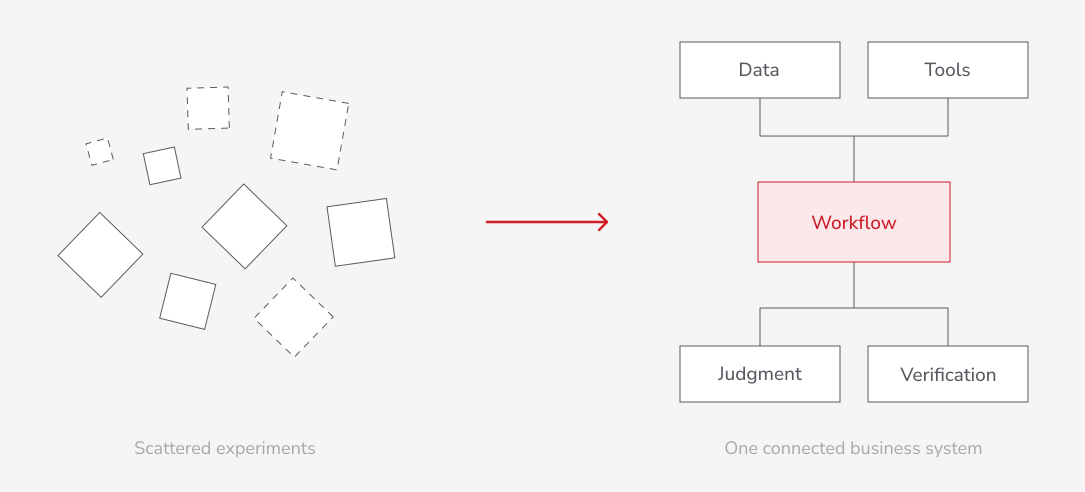
AI needs a system around it
The model is only one part of the solution.
A useful AI system needs:
- Context – what does the business know?
- Data – what information should AI use?
- Tools – what systems can it read or update?
- Rules – what may it do?
- Verification – how do we catch mistakes?
- Escalation – when does a person take over?
DORA’s research shows why the surrounding system matters: documentation, feedback, delivery discipline, and a healthy internal platform influence whether faster AI-assisted work becomes a stronger outcome.[2]
07
The productivity trap
Faster is not always better.
DORA’s earlier research found that greater AI adoption was associated with improvements in documentation quality, code quality, and review speed, while also being associated with weaker software-delivery stability in the studied context.[2]
The lesson extends beyond software:
- More leads can overwhelm sales.
- More reports can create less attention.
- More features can create more maintenance.
- More content can reduce quality.
- More analysis can delay decisions.
Stripe Economics reaches a related conclusion from the productivity literature: time saved by AI does not reliably become more output unless people have the autonomy or incentives to redirect that capacity productively.[7]
Measure the loop
Not the amount produced.
08
Keep humans where judgment matters
The goal is not maximum automation. It is better allocation of human attention.
AI is good at
- Search
- Extraction
- Summarization
- Classification
- Comparison
- Drafting
- Monitoring
AI + human
- Customer communication
- Recommendations
- Complex analysis
- Product decisions
- Sensitive content
Human accountability
- Strategy
- Relationships
- Ethics
- High-impact approvals
- Ambiguous cases
- Exceptions
Design question
Where does human judgment create the most value?
Automate around that point – not necessarily through it.
09
Trust is infrastructure
People use AI better when the rules are clear.
A practical AI policy should answer:
- What tools may we use?
- What information may we give them?
- Which outputs need verification?
- Which actions need approval?
- Who owns the result?
For Canadian businesses handling personal information, privacy obligations and guidance should shape the workflow from the beginning.[8] For a broader operating model, the voluntary NIST AI Risk Management Framework organizes risk work around four functions: govern, map, measure, and manage.[9]
Pieoneers principle
More autonomy, more verification.
The more an AI system can do without a person, the stronger its permissions, testing, monitoring, and escalation mechanisms need to be.
10
Measure what changes
“We use AI” is not a metric.
Start with a baseline. Then measure:
Time
- Cycle time
- Response time
- Manual effort
Quality
- Errors
- Rework
- Consistency
- Escalations
Customer
- Conversion
- Retention
- Satisfaction
- Time to resolution
Business
- Capacity
- Cost per transaction
- Revenue
- Margin
People
- Useful work
- Focus
- Trust
- Satisfaction
The question
What happened with the capacity AI created?
Hours saved matter only when they become something valuable. The Bank of Canada similarly distinguishes individual task efficiency from broader firm-level productivity, which may take longer to appear until AI is integrated into core processes.[10]
11
The AI readiness test
Before you build, answer five questions.
- What business outcome should improve?
- What is the current bottleneck?
- What happens after AI accelerates it?
- What mistakes are acceptable – and which are not?
- What data and systems does AI need to work reliably?
Score each answer: clear, partly clear, or unknown. If several answers are unknown, the next step is probably discovery, not development.
12
Prove the idea in three weeks
Start small. Validate quickly. Then scale carefully.
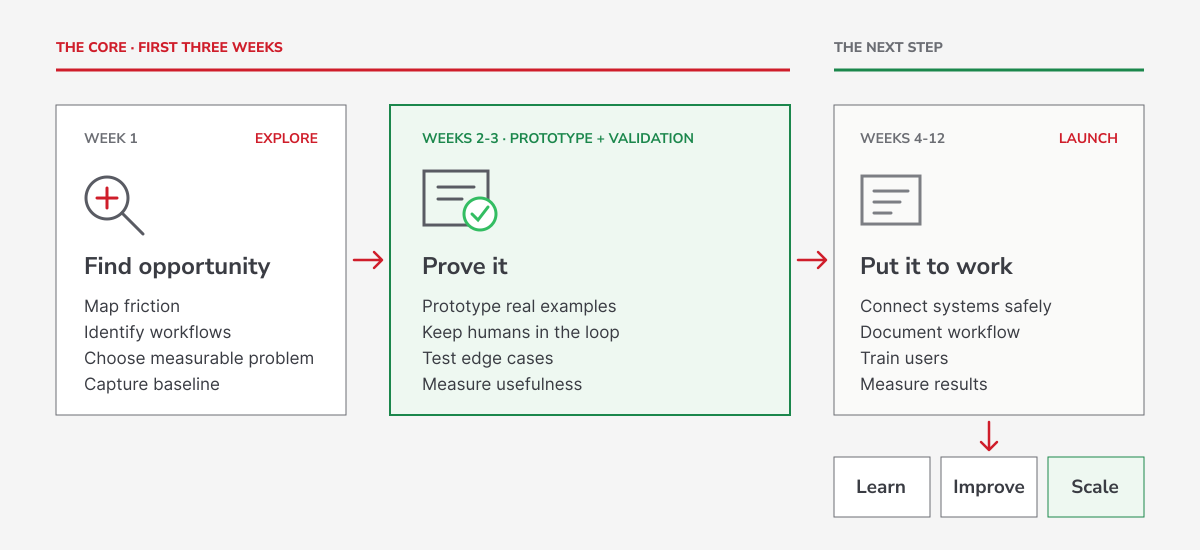
A useful prototype does not need a 90-day runway. In three focused weeks, you can learn whether an AI workflow solves a real problem and deserves further investment.
Week 1
Find the opportunity
Map friction · identify candidate workflows · choose one measurable problem · capture the baseline
Weeks 2–3
Prove it
Prototype · use real examples · keep humans in the loop · test failure cases · measure usefulness
Weeks 4–12
Operationalize
Connect real systems · add permissions · document the workflow · train users · measure results
Then
Decide
Learn from it. Improve it. Scale what works.
The first three weeks answer “Should we continue?” The remaining weeks turn a validated idea into a reliable business capability.
Canadian SMEs developing or integrating AI may be eligible for changing forms of public support, including NRC IRAP’s AI Assist initiative and regionally delivered programs. Treat these as programs to investigate – not guaranteed project funding – and confirm current intake, eligibility, and repayment terms before planning around them.[11][12]
13
What good looks like
The AI-native business is not the one using the most AI.
It is the one where:
- Information is easier to find.
- Routine work moves with fewer handoffs.
- People spend less time transferring information between systems.
- Customers wait less.
- Experts can support more people.
- Decisions arrive with better context.
- Software adapts to the business.
- AI remains observable and accountable.
This is consistent with OECD evidence: SMEs report benefits from generative AI, but complementary skills, policies, and responsible adoption practices remain essential.[4]
14
Where Pieoneers fits
Build the system around the AI.
Most CEOs and founders do not need another AI demo. They need to decide what is worth changing, then build the smallest reliable system that proves it.
Pieoneers works across the path:
Discover
Find high-value opportunities and the real bottleneck.
Prototype
Test the idea with real data and real failure cases.
Connect
Integrate AI with existing software and workflows.
Build
Create custom AI-enabled web and mobile products.
Measure
Evaluate quality, adoption, and business impact before scaling.
Our approach
Business problem → Prototype → Evidence → Production
Not: AI technology → Search for a problem
References
Inline markers throughout the playbook point to the sources below.
- 1.Notion. The AI Operations Playbook for Small Businesses, July 2026. Used as structural inspiration for progressive storytelling, concise pages, and visual economy; not as the operating model of this playbook.
- 2.Google Cloud DORA. Impact of Generative AI in Software Development, and the 2025 State of AI-assisted Software Development Report. Research on productivity, documentation, trust, feedback loops, delivery performance, and AI as an organizational amplifier. Report page.
- 3.Statistics Canada. Analysis on artificial intelligence use by businesses in Canada, second quarter of 2025, June 16, 2025. Reports that 12.2% of Canadian businesses used AI to produce goods or deliver services in the preceding year, up from 6.1% one year earlier. Source.
- 4.OECD. Generative AI and the SME Workforce: New Survey Evidence, 2025. Survey of more than 5,000 SMEs across seven countries, covering adoption, employee performance, skills, workload, barriers, and responsible preparation. Source.
- 5.Board of Governors of the Federal Reserve System. Monitoring AI Adoption in the U.S. Economy, FEDS Notes, April 3, 2026. Synthesizes major U.S. business and household surveys and reports that roughly 18% of firms had adopted AI by the end of 2025. Source.
- 6.Google AI & Economy. ATLAS v1.0: Activity, Task, Landscape, and Adoption Study, 2026. Analysis of 14.65 million de-identified Gemini interactions; used here only for the distinction between collaborative assistance and full task automation. Program page. Paper.
- 7.Ernie Tedeschi, Stripe Economics. AI and Productivity, July 2026. Reviews evidence on worker- and firm-level gains and the importance of reallocating time saved by AI. Source.
- 8.Office of the Privacy Commissioner of Canada and provincial and territorial privacy authorities. Principles for responsible, trustworthy and privacy-protective generative AI technologies. Guidance for organizations developing, providing, or using generative AI under applicable Canadian privacy law. Source.
- 9.National Institute of Standards and Technology. Artificial Intelligence Risk Management Framework (AI RMF 1.0), NIST AI 100-1, January 2023. Voluntary, sector-agnostic framework organized around govern, map, measure, and manage. NIST notes that version 1.0 is under revision. Source.
- 10.Bank of Canada. Canadian Survey of Consumer Expectations, First Quarter of 2026, Box 1. Discusses the difference between individual task efficiency and broader productivity from integrating AI into production processes and operations. Source.
- 11.National Research Council Canada Industrial Research Assistance Program (NRC IRAP). NRC IRAP support for SMEs innovating with artificial intelligence. Overview of AI Assist support for eligible innovative Canadian SMEs developing or adapting generative AI and deep-learning solutions. Program availability and eligibility should be confirmed directly. Source.
- 12.Government of Canada. Regional Artificial Intelligence Initiative (RAII). Regionally delivered support intended to help businesses commercialize and adopt AI; delivery, intake status, contribution type, and eligibility vary by regional development agency. Program overview.
Funding programs change frequently. Confirm current status with the administering agency before acting on it. This playbook offers operational guidance, not legal advice; privacy and sector-specific obligations vary by jurisdiction and use case.
Decide what is worth changing
Bring us one workflow that is slow, repetitive, or blocking your customers. We will help you find the bottleneck, prove the idea with real data, and build only what earns its place.
Get In Touch