
← Go back
Build vs. Buy Software: Custom App or SaaS?
 Olena Tkhorovska
AI has not made off-the-shelf software obsolete. It has changed the economics of deciding what to buy and what to build.
Businesses can increasingly afford to own the focused workflows that create an advantage while continuing to rent the mature platforms around them. The question is no longer whether to replace SaaS. It is which parts of your operation are strategically worth owning.
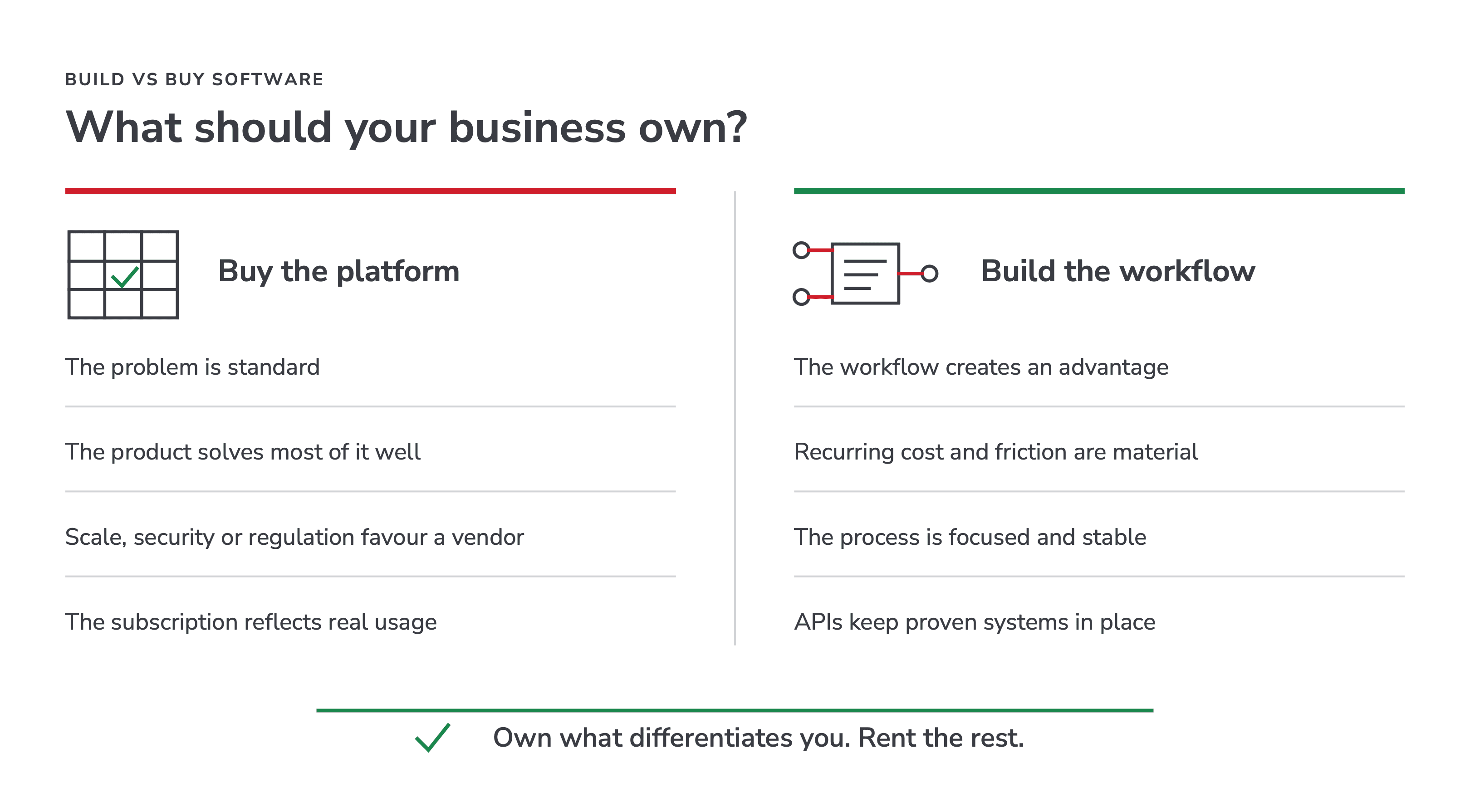
Build-versus-buy software framework showing when to buy a mature platform or build a focused workflow, with the principle: own what differentiates your business and rent the rest.
What should you own, and what do bicycles have to do with it?
For decades, “don’t reinvent the wheel” has been good advice in software. Why build something that already exists? Buy the software, subscribe to the service, and let a vendor spread the cost of developing and maintaining it across thousands of customers.
That logic helped create the SaaS economy. And for the most part, it still makes sense. But AI is changing one side of the equation: what software costs to create. That makes an old question worth asking again.
Maybe, sometimes, you should reinvent the wheel.
The bicycle paradox
There is something amusing about the metaphor itself. In 2025, Scientific American revisited a classic graphic first published in 1973 comparing the energy efficiency of different forms of locomotion. Humans are not particularly efficient movers on our own. Put a human on a bicycle, though, and we become one of the most energy-efficient land travellers in the animal kingdom. [1]
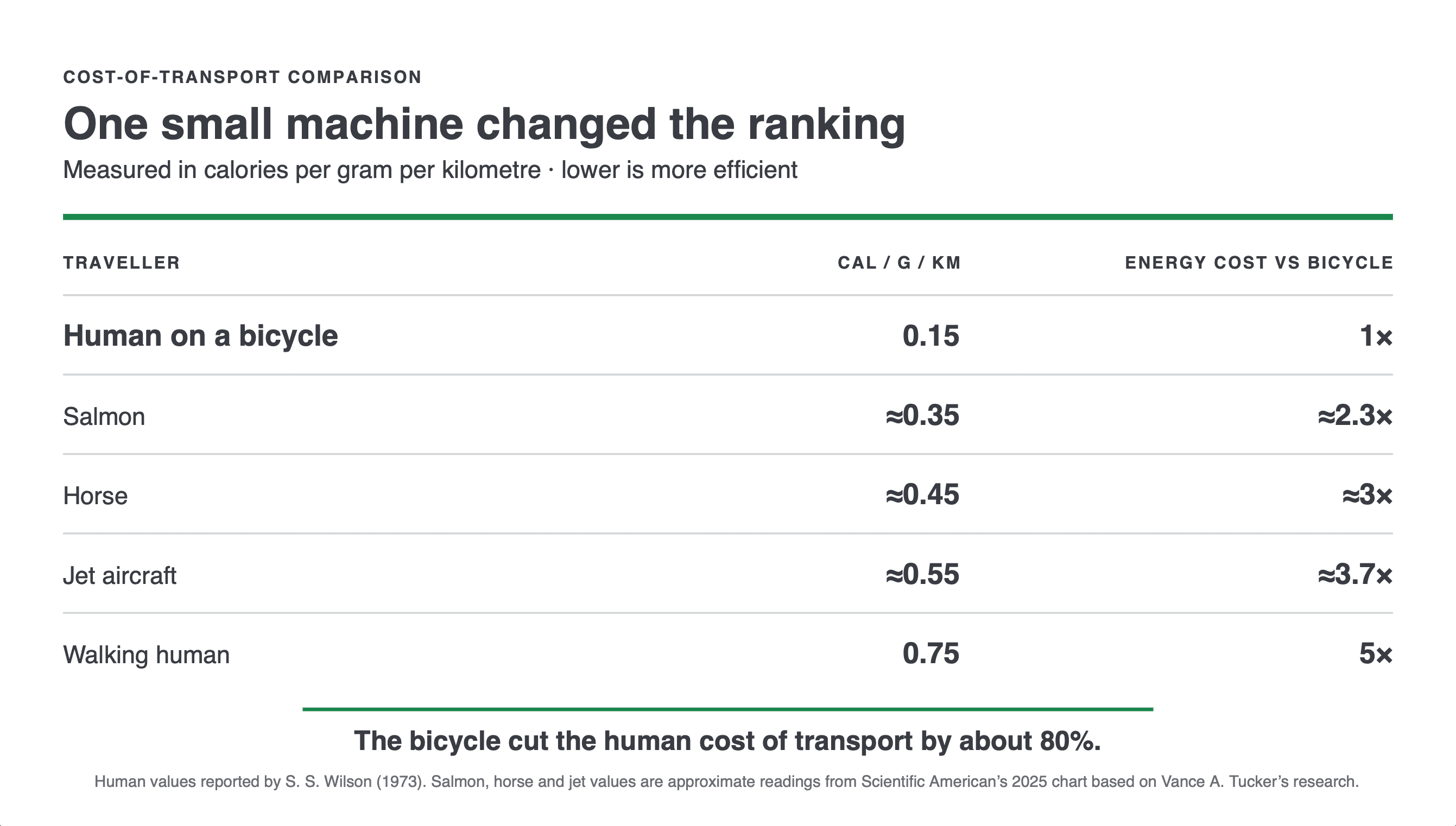
A human on a bicycle uses 0.15 calories per gram per kilometre, compared with approximately 0.35 for a salmon, 0.45 for a horse, 0.55 for a jet aircraft and 0.75 for a walking human.
The bicycle is simple: two wheels, a frame, pedals and bearings. It doesn't try to be a car, an airplane and a cargo ship at the same time. That is an interesting way to think about business software today. Perhaps the mistake isn't reinventing a bicycle.
The mistake is rebuilding a Boeing 737 when all you need is a bicycle.
Why buying software became the obvious choice
Software has traditionally been expensive to build. A SaaS company could invest millions into a product and divide that cost among thousands or millions of customers. Every customer benefited from engineering, security, infrastructure, updates and continued product development that would have been far too expensive to reproduce internally.
The model worked extremely well. It also encouraged software companies to expand.
To reach larger markets, products accumulated more capabilities. CRM systems became sales platforms. Project management tools added documents, dashboards, automation and AI. Marketing tools expanded into suites. HR systems became employee platforms.
Over time, businesses accumulated stacks of these systems. BetterCloud's 2025 State of SaaS research found an average of 106 SaaS applications per company in its survey. More than half of respondents said budget pressure combined with underused applications and licences was driving consolidation or spending cuts. [2]
At Pieoneers, we're a relatively small company, yet our own software subscriptions can cost roughly $50,000 to $80,000 a year across a couple of dozen systems. That doesn't mean we should start rebuilding them. Most are worth keeping, but a few deserve another question.
Are you buying a platform when you need a workflow?
This is where the economics become interesting. Imagine paying $15,000 or $30,000 a year for a business platform because your team depends heavily on one particular part of it.
Perhaps you need to:
- collect information from clients and turn it into a structured assessment;
- route an approval through several people;
- reconcile information between two systems;
- generate a specialized report;
- manage one unusual operational workflow;
- transform data before moving it into another system.
Historically, building software to solve that narrow problem often made little sense. The annual SaaS bill might be irritating, but commissioning custom software was considerably more expensive. AI-assisted app development is lowering the cost of building focused tools around specific business workflows.
Andreessen Horowitz described this shift particularly well in 2025. As the cost and complexity of creating software fall, they argue that businesses can begin turning the “long tail” of workflows and edge cases that off-the-shelf software couldn't serve into dedicated tools. [3]
AI is lowering the minimum economically viable size of a software problem.
That is a much bigger change than simply making programmers faster. Problems that were once too small to justify custom development may no longer be too small.
AI hasn't killed SaaS. It has changed the threshold.
This doesn't mean every company should start replacing its software stack. Far from it. Payroll software is complicated for good reasons. Accounting systems encode years of domain knowledge. Mature collaboration products benefit from network effects. Healthcare systems may carry significant security, interoperability and compliance requirements.
Rebuilding mature infrastructure just because an AI coding tool can generate an application is rarely a sensible business decision.
Buying software is no longer automatically the default.
There is another category beyond replacing or recreating existing software. Some AI-native products make previously impractical capabilities possible:
- a voice-first assistant that lets field technicians work hands-free
- computer vision that helps clinicians assess a medical condition
- smartphone video that turns movement into measurable health data
- acoustic models that identify potentially meaningful patterns in coughs and breathing
Recent research, for example, has demonstrated the use of ordinary smartphone video to assess Parkinson's-related gait impairment [7] and explored speech, breathing and cough sounds as digital biomarkers for respiratory health. [8]
These products are not smaller versions of existing platforms. They exist because AI can interpret forms of unstructured information—speech, images, movement and sound—that conventional business software could mostly store but not understand.
That does not remove the need for clinical validation, security or human oversight, particularly in healthcare and other high-consequence environments. But it expands the decision beyond whether to reproduce an existing workflow more cheaply. Sometimes the opportunity is to build a capability that did not meaningfully exist before.
Gartner's August 2026 research on application decisions makes essentially this point. It warns organizations against treating the replacement of existing applications with AI-built alternatives as a simple either/or choice. [4]
The practical build-versus-buy decision does not always require replacing an entire system. Often, the strongest answer is to keep the parts a platform does well and build the missing layer around it. Your architecture might become:
Existing SaaS + APIs + a purpose-built workflow + AI
The CRM remains the system of record, the payment provider keeps processing payments, and the EHR continues storing clinical records. But the unusual workflow that makes your organization different can belong to you.
When does custom app development make sense?
The question isn't whether custom software is “better” than SaaS. It is whether a specific workflow is worth owning. A custom business application becomes worth considering when the recurring cost and operational friction of SaaS exceed the long-term cost of ownership.
A purpose-built tool becomes interesting when several conditions appear together: you are paying a meaningful recurring cost but use only a small portion of the platform; the workflow is stable and specific to how your organization operates; and employees rely on spreadsheets, exports, manual data entry or other workarounds to bridge gaps between existing products.
It also helps when the systems involved provide reasonable API or data access, allowing the new tool to complement them instead of replacing everything. Most importantly, the economics should make sense over several years rather than only in month one.
There is no universal formula. The analysis should include the subscription itself, implementation, unused licences, manual work, integrations, maintenance, infrastructure, security and the opportunity cost of having employees repeatedly work around software that doesn't quite fit.
That is a total-cost-of-ownership decision, not a comparison between a monthly subscription and an initial development quote.

Olena and Andrew putting bicycle efficiency to a decidedly unscientific test.
Sometimes the answer should still be: buy the SaaS
There are plenty of situations where buying remains the obvious choice. If a product solves a commodity business problem extremely well, replacing it probably creates cost without creating advantage. If its ecosystem is important, regulations change constantly, the vendor's scale creates meaningful security advantages, or your business uses most of the product, keep it.
Custom software has its own cost. You own the decisions, the integrations, the maintenance and the consequences when something changes. AI reduces the cost of producing code, but it doesn't eliminate the cost of owning software. That distinction is easy to lose in the current AI enthusiasm.
The demo-to-production gap still exists
There is another version of the AI story that goes roughly like this: describe the application you want, generate it, and you're done. For prototypes, we are getting remarkably close to that world. Production is different.
Andreessen Horowitz puts the distinction succinctly: “Flashy demos are easy. Substantive products are hard.” Real software has unpredictable users, messy data, permissions, integrations, security requirements, failures and edge cases. AI adds its own unpredictability on top. [3]
This is particularly important in healthcare, wellness, financial services, education and other environments where software can handle sensitive information or influence consequential decisions. AI can dramatically accelerate development, but it cannot decide what should be built, how dependable it needs to be or what risks your organization should accept. As creating software becomes easier, software judgment becomes more valuable.
SaaS economics are changing too
The change isn't happening only on the development side. AI is also changing how software vendors charge.
Traditional SaaS grew around subscriptions and seats. But AI creates variable computational costs that don't necessarily correspond to how many employees have accounts. Stripe now describes usage-based, hybrid and outcome-based models alongside traditional subscriptions and warns that per-seat pricing can poorly match products whose value and cost scale primarily with usage. [5]
Zylo's 2026 SaaS Management Index shows another side of the shift. In its dataset, SaaS portfolio size was roughly flat while spending increased about 8%. Seventy-eight percent of surveyed IT leaders reported unexpected charges related to AI features or consumption pricing. [6]
Businesses are therefore being squeezed from both directions: software is becoming cheaper to create, while the software they rent is becoming more complicated to price. That makes renewal time a particularly good moment to reconsider old assumptions.
Before the next SaaS renewal, ask a different question
Most software renewal conversations begin with:
Should we renew this platform?
A better conversation might begin one level lower:
What do we actually need this platform to do?
Then look at the answer. Perhaps you rely on twenty things it does exceptionally well. Renew it. Perhaps the main problem is configuration or integration. Fix that. Perhaps one missing workflow is causing all the pain. Build that layer and keep the platform underneath.
Or perhaps you're paying year after year for an enormous product because of one relatively simple capability. Then maybe it's time to build the bicycle.
The goal isn't to own more software. It is to own the software that is strategically worth owning, and rent the rest. AI hasn't made SaaS obsolete; it has simply made build versus buy a real decision again.
For a growing number of narrow business problems, the little custom bicycle may turn out to be surprisingly efficient.
Before you renew or rebuild, examine the workflow.
Pieoneers helps business and technology leaders determine when SaaS is the right answer and when a focused custom app creates lasting value. Bring us the workflow, recurring costs and constraints. We’ll help you clarify what to keep, what to build and what is worth owning.
Contact Us Today. Discuss your build-versus-buy decision.
References
- Allison Parshall & DTAN Studio, “A Human on a Bicycle Is among the Most Efficient Forms of Travel in the Animal Kingdom,” Scientific American, October 14, 2025. Based on the magazine's original 1973 Bicycle Technology comparison.
- BetterCloud, 2025 State of SaaS, April 30, 2025.
- Kimberly Tan, Joe Schmidt, Marc Andrusko & Olivia Moore, “From Demos to Deals: Insights for Building in Enterprise AI,” Andreessen Horowitz, June 24, 2025.
- Gartner, “Tool: Build vs. Buy Application Decisions for AI Development or SaaS”, August 11, 2026.
- Stripe, “AI SaaS Pricing Models: A Guide for Founders”, updated April 19, 2026.
- Zylo, 2026 SaaS Management Index, 2026.
- Jianda Han et al., “Deep Learning-Enabled Accurate Assessment of Gait Impairments in Parkinson's Disease Using Smartphone Videos,” npj Digital Medicine, 2026.
- Joan B. Soriano & Sara Lumbreras, “The Rise of Artificial Intelligence in Respiratory Primary Care and Pulmonology: A Scoping Review,” npj Primary Care Respiratory Medicine, 2026.

Olena Tkhorovska
CEO at Pieoneers