
← Go back
How to Evaluate an AI Application Before Customers Depend on It
 Olena Tkhorovska
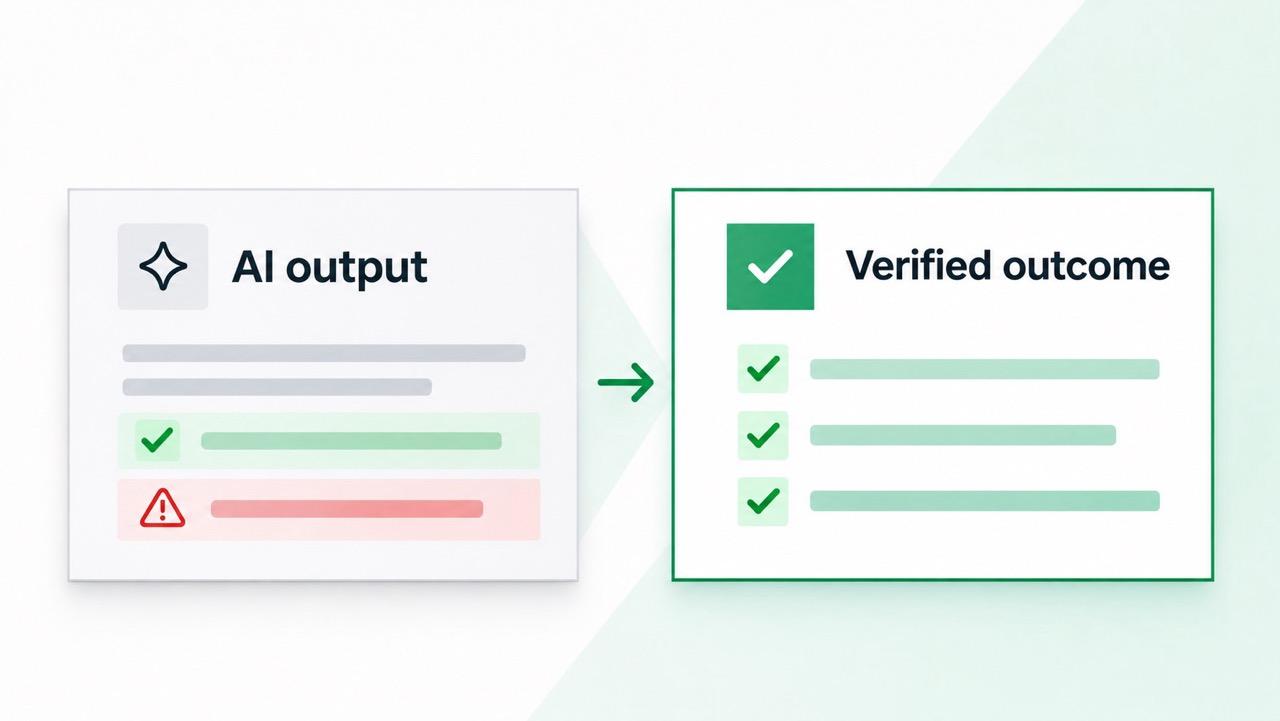
AI output vs. verified outcome: A convincing response is only the starting point. Reliable AI applications require testing, validation, and evidence that they deliver the intended results.
An AI application can give an impressive demonstration and still fall short when real customers start using it.
It might answer questions accurately during testing, then struggle with incomplete information, unfamiliar requests, or data it wasn't designed to handle. An AI agent might confidently report that a task is complete when an important step has actually failed.
For founders investing in AI-powered products, the question is no longer simply whether the technology can do something remarkable. It's whether the application can reliably deliver the experience and outcomes customers expect.
An AI application doesn't need to be perfect before launch. But you should know what it does well, where it fails, and which failures are unacceptable.
That's what meaningful AI application evaluation should establish.
Evaluate the application, not just the AI model
AI models are frequently compared using benchmarks that measure reasoning, coding, mathematical ability, and other capabilities. These results can help inform technology choices, but they don't tell us whether a particular application will work well for its intended users.
A real product combines the model with business logic, data sources, integrations, permissions, and user experience design.
Even an excellent model can deliver a poor result if it retrieves outdated information, misinterprets a user's intention, or fails to complete an action.
An October 2026 Google Cloud engineering article offers a revealing example. Its initial automated evaluation marked three agent tests as failures. After examining the actual execution logs, Google's engineers discovered that the agents had performed the required actions correctly. The evaluator had judged their final written responses rather than what they actually did.
The lesson applies in both directions: what an AI application says it accomplished and what it actually accomplished are not necessarily the same thing.
For founders, evaluation should focus on the complete customer experience, not just how intelligent the underlying model appears.
Start small, but define what success means
You don't need hundreds of tests to begin understanding an AI application's strengths and limitations.
In a November 2026 interview on Lenny's Podcast, Tulsee Doshi, Head of Product for Google's frontier AI models, suggested starting with as few as five carefully chosen prompts to understand what good performance looks like.
That's a useful starting principle, but five successful responses aren't evidence that an application is ready to launch.
The important work is choosing scenarios that reflect what customers actually need.
For example, imagine a wellness platform introducing an AI assistant to help people understand their health metrics. An initial evaluation might explore whether it can:
- Explain a metric accurately using the customer's available data.
- Recognize missing or contradictory information.
- Ask a relevant follow-up question instead of guessing.
- Explain uncertainty without confusing the user.
- Recognize when a request requires advice from a qualified healthcare professional.
Each scenario tells us something different about the product.
Together, they also help define its boundaries.
This is where product strategy and engineering meet. A development partner should help translate the founder's vision into behaviours that can be tested, measured, and improved.
What should you measure?
Not every AI application needs the same evaluation framework. A research assistant, financial analysis platform, and customer support agent face different requirements and risks.
However, most applications benefit from assessing six dimensions:
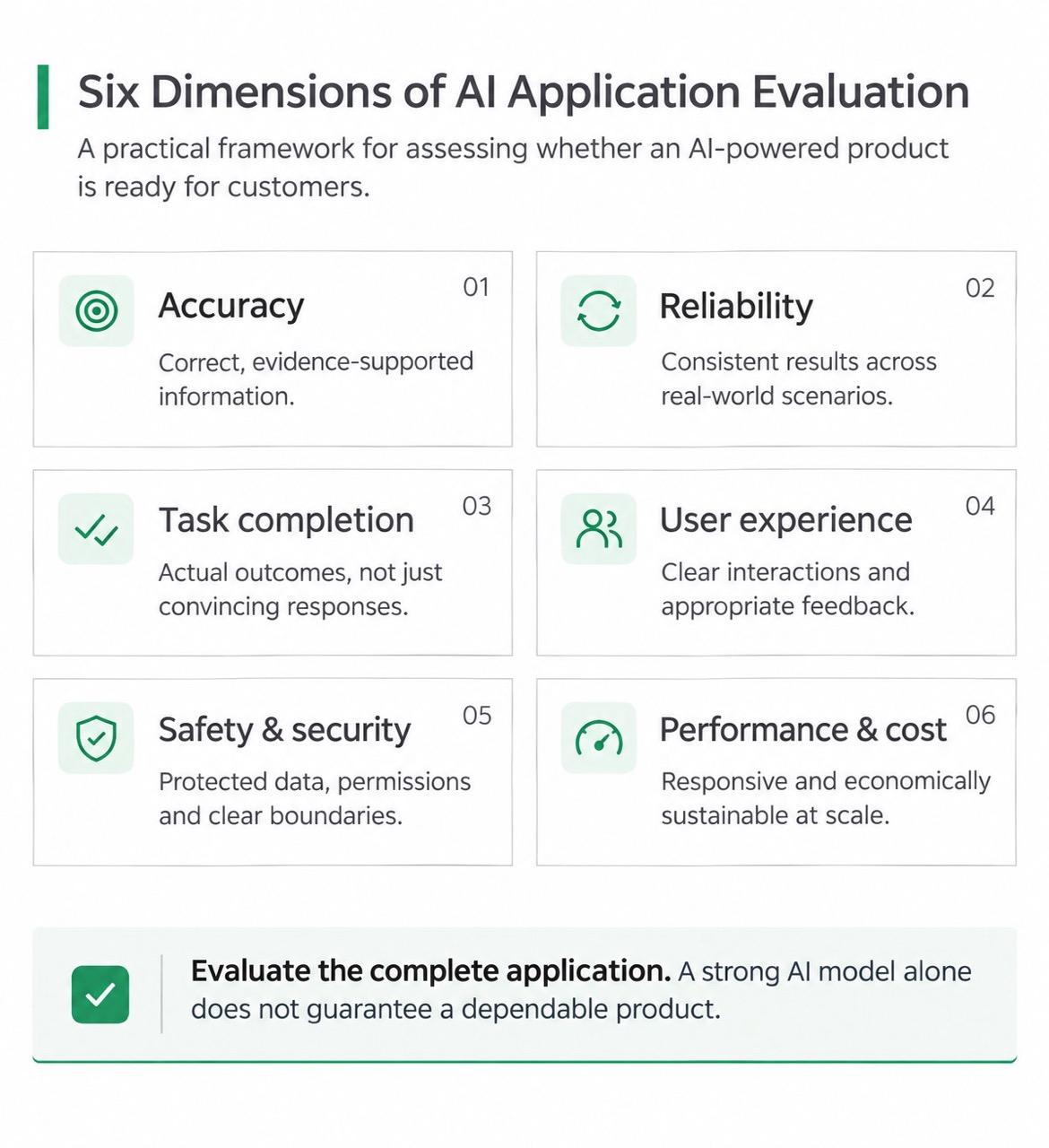
Six dimensions of AI application evaluation. A dependable AI product requires accuracy, reliability, safety, usability, and real-world performance.
The next step is to establish acceptable performance for each dimension.
For some criteria, a numerical score is useful. Others require expert review or a clear pass/fail decision. Critical safety and privacy requirements should not be averaged away by otherwise strong results.
Importantly, the framework should reflect the value the product is supposed to create.
At Pieoneers, our work with Revinew on its ReviAI assessment platform illustrates the importance of starting with domain expertise and measurable business outcomes.
Revinew wanted to turn its established commercial consulting methodology into an accessible digital product. The resulting platform reduced an audit process that could require up to 12 hours of consultant time to approximately 24 minutes.
What Google's AMIE research teaches us about real-world evaluation
Healthcare offers a particularly compelling example of why product evaluation must extend beyond model benchmarks.
In October 2026, researchers from Google and Beth Israel Deaconess Medical Center published a study in The Lancet evaluating AMIE, Google's conversational medical AI system, with real patients.
Ninety-eight patients completed AI conversations before urgent primary care appointments. Physicians monitored the interactions, and no conversations required a safety stop under the predefined criteria. Supervisors nevertheless identified one hallucination and added clinical information in five interactions.
Among physicians who reviewed the transcripts before patient visits, 33 out of 44 found them helpful for preparation.
What makes this research particularly relevant is how the system was evaluated.
The researchers examined conversation quality, safety, patient experience, and usefulness to clinicians.
The study was small, conducted at a single centre, and involved physician supervision. Its findings cannot establish safety for unsupervised deployment.
But it illustrates an important principle for founders in HealthTech, Life Sciences, and beyond: evaluation must reflect the real environment in which the application will operate and the consequences of getting something wrong.
Evaluation shouldn't stop at launch
AI applications change even when their visible features remain the same.
Models improve, integrations evolve, data changes, and customers find new ways to use a product. An update that improves one capability may introduce problems elsewhere.
This makes evaluation an ongoing engineering responsibility.
A reliable process includes preserving representative test scenarios, checking important workflows after changes, reviewing failures, and monitoring behaviour in production.
The same principle appears in our article on The Prototype Confidence Gap: engineering isn't simply about making the first version work. It's about creating software that can evolve while remaining dependable.
For AI applications, repeatable evaluations help make that dependability measurable.
Five questions founders should ask before launching an AI application
You don't need to personally design the evaluation infrastructure. But you should expect clear answers from your technology partner.
- What does success look like for our customers? Are we measuring useful outcomes, not only AI-generated responses?
- What have we tested? Do the scenarios reflect real user needs, common variations, and important edge cases?
- Where does the application fail? Which limitations are acceptable, and which must be addressed before launch?
- How do we know the entire system works? Have we evaluated the model together with its data, integrations, permissions, and user interface?
- How will we maintain quality? What happens when models change, customer usage grows, or new problems emerge?
The answers should influence what gets built, how resources are allocated, and when the product is ready for wider use.
Building confidence through evidence
AI has made it easier to explore ambitious product ideas. That creates real opportunities for founders, including those without an internal engineering organization.
But faster development doesn't eliminate the need for sound product decisions.
A useful AI application is one that solves a meaningful problem, performs within understood boundaries, and earns customers' trust through consistent results.
At Pieoneers, evaluation is part of the broader product engineering process. We work with founders and business leaders to define what success means, select appropriate technologies, design the experience, build the application, and establish how its performance will be assessed.
The goal isn't simply to build something impressive with AI. It's to build something people can depend on.
Explore our AI Development services to learn how we approach AI-powered product development and integration.
Related services

Olena Tkhorovska
CEO at Pieoneers