
← Go back
Build with Fun, Care, and First Principles
 Olena Tkhorovska
Pieoneers team client call on Google Meet, all smiling.
What a conversation with Shopify founder Tobi Lütke made me think about product building, AI, and the things that remain deeply human.
I recently listened to Tobi Lütke, founder and CEO of Shopify, on Lenny's Podcast. There was plenty in the conversation about product development, leadership, first-principles thinking and the unusual way Shopify operates. It was refreshing to hear these ideas from the founder of a company built in Ottawa rather than from another Silicon Valley story.
One strong observation stayed with me:
Pessimism sounds sophisticated. Optimism sounds naive.
It made me think… I’ve seen this too many times.
I am an optimist by nature. It always took some extra courage for me to show my true optimism at the risk of looking silly. But the more I thought about the conversation, the more I realized that the interesting part wasn't optimism itself.
It was what optimism permits a builder to do. To look at something that already exists and believe it could work better. To question assumptions that have become invisible through familiarity. To imagine a better experience before knowing exactly how to build it. And then to care enough to actually build it.
The optimism, first-principles thinking, curiosity, and genuine care for the product-feels particularly important today.
AI is giving us extraordinary new capabilities. Things that were difficult or prohibitively expensive a few years ago can sometimes be prototyped in days. But a working AI prototype and a production-ready product are still very different things. Interfaces can understand natural language. Software can interpret images, create stories, summarize complex information, find patterns and converse with us.
The temptation is to start with the technology.
I think the more interesting question is the opposite:
What would we build if we started with the human problem from scratch?
Optimism as a product skill
Tobi describes his own energy source as dissatisfaction with the status quo.
I like that definition of optimism. It isn't a belief that everything will work out. It is a belief that the current answer does not have to be the final answer.
There is evidence that optimism matters in entrepreneurship. A 2025 meta-analysis found positive associations between optimism and entrepreneurial intention, performance and wellbeing. The research doesn't suggest that optimism magically produces successful companies, and excessive optimism can obviously create its own blind spots. What it does suggest is that seeing possibility where others see constraints is not merely an eccentric founder trait. [1]
The version that interests me is disciplined optimism.
Believe something better is possible. Build toward it. Look closely at what happens. Change your mind when reality tells you something different.
First principles: don't automate yesterday
The systems we use today contain decisions made years ago: decisions shaped by the available technology, budgets, regulations, devices, organizational structures and habits of their time.
Some of those decisions remain wise. Others survive simply because nobody has asked the question again.
First-principles product thinking doesn't mean rejecting everything that came before. It means separating the real constraint from the historical constraint.
We see this frequently in our work at Pieoneers.
One of our recent projects is with RST Instruments (part of Orica Ltd) on software used with precision measurement hardware in construction and geotechnical environments. Their existing field computer was becoming obsolete, expensive and increasingly difficult to develop for.
If the question had been How do we improve the old field computer?, the solution space would have remained narrow.
Instead, modern Android devices, Bluetooth and updated mobile technology changed the building blocks. The specialized field computer could become an app running on devices engineers already knew how to use, while still communicating with sophisticated measurement hardware.
The same principle appeared at a very different scale with GameSheet. When adoption was about to move from a relatively small user base to tens of thousands, load testing showed us that incremental optimization of the original architecture wasn't the right answer. We rebuilt the underlying platform while preserving something valuable from the old world: the familiar mental model of a paper game sheet that scorekeepers already understood.
Questioning the status quo does not mean automatically throwing it away. Sometimes you discover that there was a great deal of wisdom encoded in it. The important part is doing the exercise. And AI makes that exercise much more interesting.
AI is not the product idea
We are now working on several products where AI is becoming a meaningful part of the experience.
In one, we are exploring how personalized storytelling can help parents talk with children about emotions and navigate big feelings together.
In another, voice-driven AI helps people find their way through complex workplace information and environments without having to understand where every piece of knowledge lives.
Elsewhere, we are exploring how AI can interpret or organize complex information that previously required much more manual interaction.
These are technically very different projects. But I don't think the interesting idea in any of them is we added AI.
The more useful questions are:
- How can a parent find the right language for this child, at this particular moment?
- Why should an employee need to understand the architecture of an organization's information before they can get an answer?
- Which part of a complex decision genuinely requires human judgment, and which part can software quietly take care of?
- AI is not the product idea. AI changes what we can build, but it doesn’t change the need to understand why we’re building it.
AI is a newly available building block.
That distinction matters because we are already seeing products designed backwards: beginning with the desire to use AI and then searching for a problem that justifies it.
First principles suggest the reverse.
a) Start with the person.
b) Then look again at everything technology can now do.
This is also why human judgment becomes more important as AI improves. Research on knowledge workers has found that AI can significantly improve speed and quality when tasks fall within its capabilities, while creating new failure modes when people over-rely on it outside those boundaries. The technology expands the solution space; it doesn't remove the need to understand the problem. [2]
Building for fun and delight
Another phrase from Tobi's conversation stayed with me: fun and delight.
These are unusual words in enterprise software.
We are more accustomed to talking about conversion, retention, efficiency, utilization or ROI. All of those matter. But they don't completely describe the experience of using a really good product.
There is an established distinction in UX between surface delight and deep delight. Surface delight might be a clever animation or a charming piece of microcopy. Deep delight comes when a product is useful, reliable and easy enough to use that the technology almost disappears into the task. [3]
A 2025 systematic review of decades of customer-delight research similarly found relationships between delight and outcomes including loyalty, recommendations and repurchase intentions. [4]
I think "delight" becomes even more interesting when we apply it to serious software.
- A therapist does not need confetti after completing a clinical note.
- A medical technician does not need a playful animation while reviewing a patient's scan.
Sometimes delight is simply complexity disappearing.
We saw this while building Sessions, a mental-health application with Delta Autumn Consulting. Their clinicians brought deep expertise in psychotherapy and had already developed the underlying clinical system. Our task was to translate that knowledge into a native, HIPAA-compliant iPad and iPhone experience that could fit naturally into therapy.
The application used technologies such as SwiftUI, PencilKit and Face ID, but those weren't really the point. The point was that a therapist should be able to organize and navigate a session without the software competing with the patient for attention.
Dr. John Young later described the interface as allowing practitioners to focus more on the patient and less on administrative tasks.
We encountered the same idea while building an administrative system for Bodycomp Imaging. The head technician told us that uploading and accessing patient information became substantially more efficient, that comparing past and current scans became easier, and-most meaningfully to me-that she appreciated the thought and care put into the system.
Fun is not the opposite of serious work
I have long believed that humans learn particularly well when there is room to play. I wouldn't make the scientific claim that play is always the best way to learn. Human motivation and learning are far more complicated than that. There is increasingly good evidence behind the broader intuition.
A 2026 meta-analysis synthesizing 192 workplace studies found that autonomy, competence, and autonomous motivation are consistently connected with adaptive outcomes including engagement, satisfaction, performance and wellbeing. [5]
Recent workplace research has also found relationships between playful work design, flow, creativity and performance. In other words, making room for enjoyment and challenge in the way we approach work isn't necessarily a distraction from serious performance. Under the right conditions, it may contribute to it. [6]
Curiosity matters too. A 2025 Scientific Reports study found that states of curiosity improved long-term memory for relevant information. [7]
None of this means every meeting needs a game or every application needs to be entertaining. To me, it points toward something simpler. People tend to do remarkable things when they remain curious enough to experiment. I can trace this theme surprisingly far back in our own work.
Years ago, we helped a Silicon Valley startup build an enterprise platform based on a large body of research around workplace happiness, engagement and productivity. At the time, the idea that happiness belonged in a serious conversation about business performance still sounded slightly unconventional.
Today the research base is much stronger. A 2025 synthesis covering studies from 27 countries found an overall positive relationship between happiness and productivity at work, while also noting important differences among occupations and the need for more causal research. [8]
Happiness and productivity research snapshot
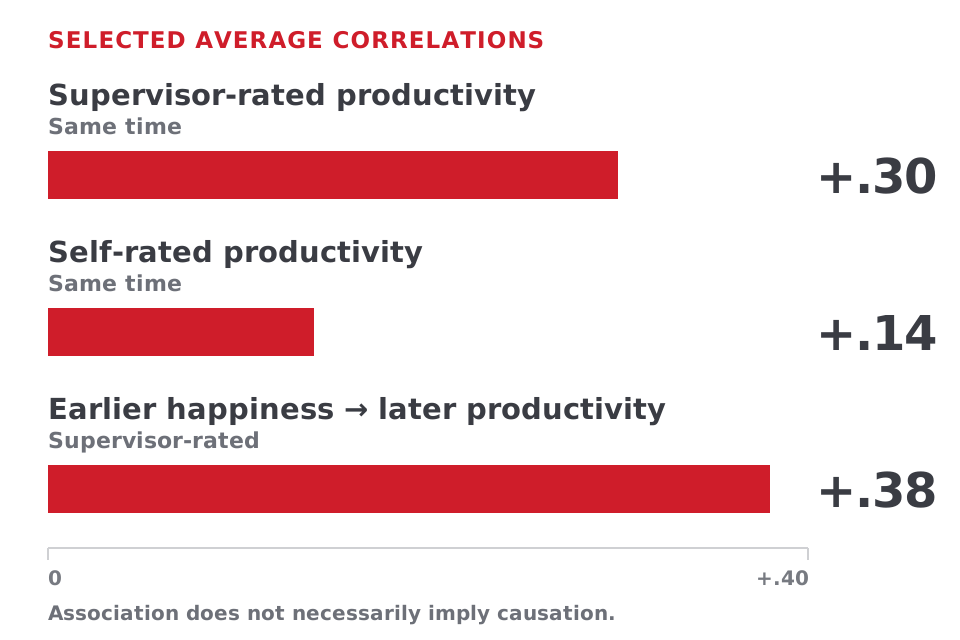
Visualization by Pieoneers based on selected averages reported in Fang, Veenhoven & Burger (2025), Management Review Quarterly. Not a reproduced figure. CC BY 4.0.
Correlation shows association, not necessarily causation.
What once sounded soft is becoming increasingly measurable.
Curiosity. Pride. Enjoyment. Trust. Care.
They often sit upstream from the things that eventually appear on the dashboard.
Caring about product is not a soft skill
Near the end of the podcast, Tobi makes perhaps his strongest product argument: great products cannot be built by people who don't genuinely care about the product.
The language is intentionally blunt. But there is something important underneath it.
Organizational researchers use the term psychological ownership to describe the feeling that something is "mine" even when there is no literal ownership. A large 2024 meta-analysis across 139 studies found relationships between psychological ownership and outcomes including task performance and constructive employee behaviour. [9]
I don't think caring can be reduced to a management technique. Care changes what people notice. Someone who cares asks whether this workflow actually makes the user's day better.
- They notice when the technically correct implementation places unnecessary cognitive load on the person using it.
- They ask what happens when someone is rushed, stressed, distracted, unfamiliar with the system or working on a small screen in the field.
- They are more willing to say that the feature described in the original requirements might not be the feature the product actually needs.
- They keep asking questions after the ticket has technically been completed.
This becomes particularly important with AI. Calling a language model API is relatively easy now. Understanding where an AI system belongs in someone's life is not.
That question becomes even more delicate in healthcare, wellness, education and products for children. The goal isn't to insert an AI between people simply because we can. It is to decide where technology can strengthen human capacity without unnecessarily replacing human agency.
Research around AI and social-emotional learning illustrates both the potential and the caution required here. Recent reviews find promising applications, including personalized feedback and emotional support, but also significant gaps around developmental appropriateness, privacy, safety and long-term effectiveness-particularly with younger children. [10]
That is precisely why caring about the product includes caring about its limits.
A few Canadian builders make this feel less theoretical
One thing I particularly enjoyed about the Tobi conversation was simply hearing this philosophy from a Canadian founder.
And Shopify isn't the only Canadian company where I see echoes of it.
Jane App started because a North Vancouver clinic owner couldn't find software that worked the way her multidisciplinary practice actually worked. The product grew from that direct understanding of the problem, paired with a developer who cared deeply about design. More than a decade later, Jane App still describes its goal in very human terms: helping practitioners spend less time managing software and more time with patients.
Their approach to AI is particularly interesting. In July 2026, Jane described its AI strategy as supporting clinical expertise rather than replacing it, and wrote about using AI to give practitioners more time to be present with patients and clients.
Wealthsimple expresses a similar philosophy in finance. Investing and financial services have historically been full of jargon, interfaces and processes that make customers feel as though complexity is unavoidable. Wealthsimple's own description of its mission is essentially a first-principles challenge to that assumption: take the complexity and make it simple.
Shopify, Jane App and Wealthsimple are very different businesses. I wouldn't argue that this is somehow a uniquely Canadian philosophy. But I do like having these examples close to home.
Each, in its own way, starts with the belief that something complicated can work better for the human being using it.
What becomes possible now?
AI is changing the building blocks available to us.
That should make product development more imaginative, but not less thoughtful.
When we begin a project now, there are a few questions I increasingly want us to ask:
- What is the person actually trying to accomplish?
- What is getting in their way?
- Which of those constraints are fundamental-and which are simply inherited from the way things used to work?
- What can technology absorb now that it couldn't absorb before?
- Where should technology deliberately stay out of the way?
- What could become simpler, more useful or more human?
There is enormous excitement right now about what we can produce with AI. But I think the more interesting opportunity is not simply bolting on some AI.
It is to look again at problems we have learned to accept, bring today's tools to them, and imagine what a better experience could be.
- To experiment.
- To remain curious.
- To have fun while figuring it out.
And then to build with enough care that the person on the other side can feel the difference.
The work is not simply building what was requested. It is discovering what becomes possible.
References
1. Optimism and entrepreneurship
Yuxiang Luan & Zixu Zhang, Optimistic entrepreneurs: a meta-analysis of optimism’s impact on entrepreneurial status, intention, performance, and well-being. Current Psychology, 2025, 44, 10696–10712. DOI: 10.1007/s12144-025-07874-0. The meta-analysis found positive associations between optimism and entrepreneurial intention, performance, and wellbeing. Springer article
2. AI capability versus human judgment
Fabrizio Dell’Acqua, Edward McFowland III, Ethan Mollick, Hila Lifshitz, Katherine C. Kellogg, et al., Navigating the Jagged Technological Frontier: Field Experimental Evidence of the Effects of Artificial Intelligence on Knowledge Worker Productivity and Quality. Organization Science, 2026, 37(2), 403–423. Organization Science paper
3. Deep versus surface delight in UX
Therese Fessenden, A Theory of User Delight: Why Usability Is the Foundation for Delightful Experiences. Nielsen Norman Group, 2017. Nielsen Norman Group article
4. Customer delight research
A systematic review of theoretical, methodological, contextual, and content-related foundations of customer delight research. Total Quality Management & Business Excellence, 2025. Systematic review
5. Motivation, autonomy and work
Martin S. Hagger & Kaylyn McAnally Star, Self-Determination Theory and Workplace Outcomes: A Meta-Analysis. Stress and Health, 2026. PubMed
Wiley article
6. Playful work and creativity
Jian Zhu & Xin Wen, Playful work design, flow, and employee creativity. Journal of Psychology in Africa, 2025, 35(2), 199–205. TechScience
7. Curiosity and learning
Alexandra Sobczak, Tineke Steiger, Marthe Mieling, et al., Curiosity and surprise differentially affect memory depending on age. Scientific Reports, 2025, 15, 32423. Scientific Reports article
8. Happiness and productivity
Happiness and productivity: a research synthesis using an online findings archive. Management Review Quarterly, 2025. Springer
9. Psychological ownership and care
Franziska M. Renz, From HR Practices to HR Performance: A Psychological Ownership Meta-Analysis Across Cultures. American Business Review, 2024, 27(1). Digital Commons
10. Emotional AI in education
Heng Zhang, Yuhan Liu, Meilin Jiang, Juanjuan Chen, Minhong Wang & Fred Paas, Emotional Artificial Intelligence in Education: A Systematic Review and Meta-Analysis. Educational Psychology Review, 2025, 37, Article 106. Springer

Olena Tkhorovska
CEO at Pieoneers