
← Go back
Great Hires Are Not Yet a Team. An Embedded Team Is.
 Olena Tkhorovska
The Pieoneers team in a working session. Shared working history is what separates a team from a group of hires.
A founder recently told me that the companies he works with would never outsource their engineering.
I understand the concern. If software defines your company, handing product development to a disconnected vendor creates risk. The founder retains the vision while an outside team waits for requirements and completes tickets. Context disappears between meetings. Important product decisions become technical assumptions.
But that is one model of outsourced software development. It is not the only one.
An embedded product team is an external product, design and engineering team that works inside the founder's decision process and carries the product from early decisions to production. The founder keeps ownership of the vision. The team supplies the capacity to execute it.
For many early-stage companies, this is a faster route to a serious product than hiring in-house. The same holds for established companies launching something new.
Hiring People and Building a Team Are Different Jobs
An internal engineering team can become a major company asset. Building one takes time.
Five strong individual hires do not become an effective team on their first day together.
LinkedIn reports that the average role takes 66 days to fill. Specialized technical and engineering positions can remain open for three to six months or longer.
A founder building a cross-functional product team may need to recruit several people in sequence. Each successful hire begins another process:
- Learning the product and market
- Establishing technical standards
- Dividing responsibilities
- Developing working relationships
- Building a reliable delivery rhythm
A study published in Management Science found that prior experience working together had a significant positive effect on software-team performance. Individual tenure did not provide the same consistent benefit.
McKinsey reached a related conclusion after analyzing more than 1,700 product teams across 75 organizations. When teams stayed together for three to six months with fully dedicated members, their estimates became more consistent. Their velocity and throughput improved.
The practical lesson is simple: experience matters, and shared experience matters differently.
An established team arrives with working relationships already in place. Its members know how to plan and challenge assumptions. They know how to resolve disagreements and move work into production.
Founder-Led Product Development
An embedded product team extends founder-level invention.
Early products evolve through close contact with customers and the founder's growing understanding of the market. Requirements change because the company is learning. That is healthy.
The founder continues to own:
- The customer problem
- The company's priorities
- The product vision
- The decisions that define its competitive advantage
The engineering team turns that direction into a working product. It also contributes judgment.
A capable team should identify when a requested feature creates unnecessary complexity. It should notice when a simpler experiment could answer the same question, or when an early technical choice will become expensive later.
This is where development becomes value engineering.
Value Engineering Goes Beyond Writing Code
Jerry Kroll, CEO of Jevitty Life Science, used the phrase cost-effective value engineering to describe Pieoneers' contribution to the Jevitty health and wellness platform.
His explanation captures the difference:
"Pieoneers grasp our mission so well they can co-create features with us."
That level of contribution requires product and business context. The team must understand the mission well enough to make useful decisions with the founder.
In practice, value engineering can mean:
- Reducing a feature to its essential user outcome
- Testing an idea before committing to full development
- Selecting an architecture that controls future operating costs
- Identifying privacy or security requirements early
- Connecting design decisions with technical constraints
- Protecting the roadmap from unnecessary complexity
The best result is rarely the largest amount of software. It is the smallest coherent product that can create value and support learning. It should also give the company a sound base for growth.
This approach starts with product planning and strategy: understanding the user, selecting the first product milestone, and connecting the founder's goals to a viable development roadmap.
AI Makes Product Judgment More Valuable
AI has made software production faster. Research, interface exploration, prototyping, testing and coding can all move more quickly.
The business value still depends on what the team chooses to produce.
In his Social Capital Deep Dive on why AI is booming while productivity is not, Chamath Palihapitiya makes the distinction clearly:
"AI lowers the cost of doing things, but does nothing about whether they were worth doing in the first place."
A team can use AI to produce ten versions of the wrong feature. It can generate code before the architecture is understood. It can accelerate a workflow that should have been removed.
AI rewards clear product direction. It also raises the cost of weak judgment, because weak decisions can now be implemented at greater speed.
Google's 2025 DORA State of AI-assisted Software Development report describes AI as an amplifier. It magnifies the strengths of high-performing organizations and the dysfunctions of struggling ones. The greatest returns come from the system around the tools: the people, their working practices, the architecture and the feedback loops that turn output into dependable software.
We explored the same idea in The AI Is the Same for Everyone. The Judgment Is Not. Access to a model is common. Judgment remains earned.
Smaller Teams Can Cover More Ground
A field experiment at Procter & Gamble shows how AI is changing product work.
Researchers randomly assigned 791 professionals to work on real product innovation challenges, alone or in pairs, with and without AI.
Individuals using AI produced work comparable in quality to two-person teams without AI. AI also helped commercial and R&D professionals generate more balanced proposals outside their usual domains.
The study also shows where people still matter. AI mainly raised the quality of the ideas participants generated. Human judgment kept its value in choosing among them. In the earlier working paper, teams using AI were about three times as likely as individuals without AI to produce a top-10% solution.
AI expanded production. Human collaboration remained valuable for evaluation. The strongest results came from combining both.
This points toward smaller, more capable product teams. AI expands the range of an experienced professional. It expands further the range of a team whose members already know how to work together. Our earlier review of research on team size and AI reached the same conclusion from a different direction.
At Pieoneers, we call this the smallest complete team: the smallest group that can genuinely own the product outcome, from strategy through delivery.
Coordination Is the New Bottleneck
AI can return an answer in seconds. Companies still lose weeks to unclear ownership, delayed decisions, and handoffs between disconnected contributors.
Palihapitiya makes a related point in the same Deep Dive. AI mostly speeds up production, while much of a corporate employee's week goes to coordination, alignment and sign-offs. If the time AI saves flows into another meeting, the return is zero.
Faster production can increase this pressure. More prototypes require review. More code requires integration. More options require decisions. We wrote about this effect in AI Helps Us Produce More. When More Is Too Much.
An established team reduces that coordination burden:
- Product and engineering decisions happen together.
- Designers understand the technical constraints.
- Engineers understand the customer outcome.
- Testing begins before release.
- The founder has one working team instead of several individual relationships to manage.
This is especially important at the early stage. A founder's time is divided across customers, financing, partnerships and company operations. Managing several newly hired specialists can become another full-time responsibility.
An embedded team gives the founder a functioning delivery unit from the beginning. Our article on app development with Claude Code shows how a senior team and client work together through planning, implementation, review and production delivery.
When an Embedded Product Team Fits
This model is well suited to companies with an active founder and a meaningful product opportunity, but without a complete internal team.
It is worth considering when:
- The founder is shaping the product through customer learning.
- The company wants senior expertise and a cohesive team without building an engineering department.
- The company needs to reach a market milestone within months.
- The work requires product strategy, design and engineering together.
- The product involves AI, sensitive data, or complex integrations.
- Recruiting a full team would consume the current market window.
- The founder wants close involvement without managing each contributor.
- The product needs ongoing evolution from people who already know it.
- The company needs production software rather than another prototype.
The product itself varies. At Pieoneers, embedded engagements have covered mobile app development for iOS and Android, full-stack web platforms, and AI-enabled products. Revinew turned a proven go-to-market methodology into an AI-powered assessment platform. GameSheet needed a web platform and an iPad app for youth sports scorekeeping.
For founders who already have an AI-built proof of concept, the decision may be narrower: assess the code, preserve what works, and engineer the rest for production. Pieoneers' AI prototype-to-production service is designed for that stage. Our article on the prototype confidence gap explains why a working demo and a production system are different things.
When an Established Company Launches a New Product
The model also works for established organizations launching a new digital product.
Their internal technology teams are often fully committed to current systems. They may lack a needed specialty, such as AI integration or native mobile development. They may also operate on a delivery schedule built for maintenance rather than a new launch.
An embedded product team can work alongside internal engineering without pulling it off existing commitments. In this setting, the team should:
- Follow the company's security, review and deployment standards
- Work with internal architects on integration points from the start
- Keep documentation and decision records inside the company's own systems
- Plan the handover to internal owners before the first release
For organizations that need an independent view of an existing codebase first, a code review and security audit is often the right starting point.
When an Internal Team Fits
An internal team is often the right long-term structure when the company has stable funding and experienced technical leadership, with enough continuing work to support permanent roles.
It is especially appropriate when:
- The engineering research itself is the core intellectual property.
- Daily technical operations require permanent internal ownership.
- The company can recruit and lead every required discipline.
- The product roadmap is mature enough to define long-term positions.
- The organization can support hiring while meeting its market commitments.
The choice can change over time.
An embedded product team may build the first production system and establish working practices. It can then help the company identify which permanent roles it needs. Internal hiring can proceed from an operating product instead of a speculative organization chart.
The transition should be planned. Documentation, architecture records, deployment processes and product context must remain accessible to the company.
Embedded Team, In-House Team or Freelancers: How They Compare
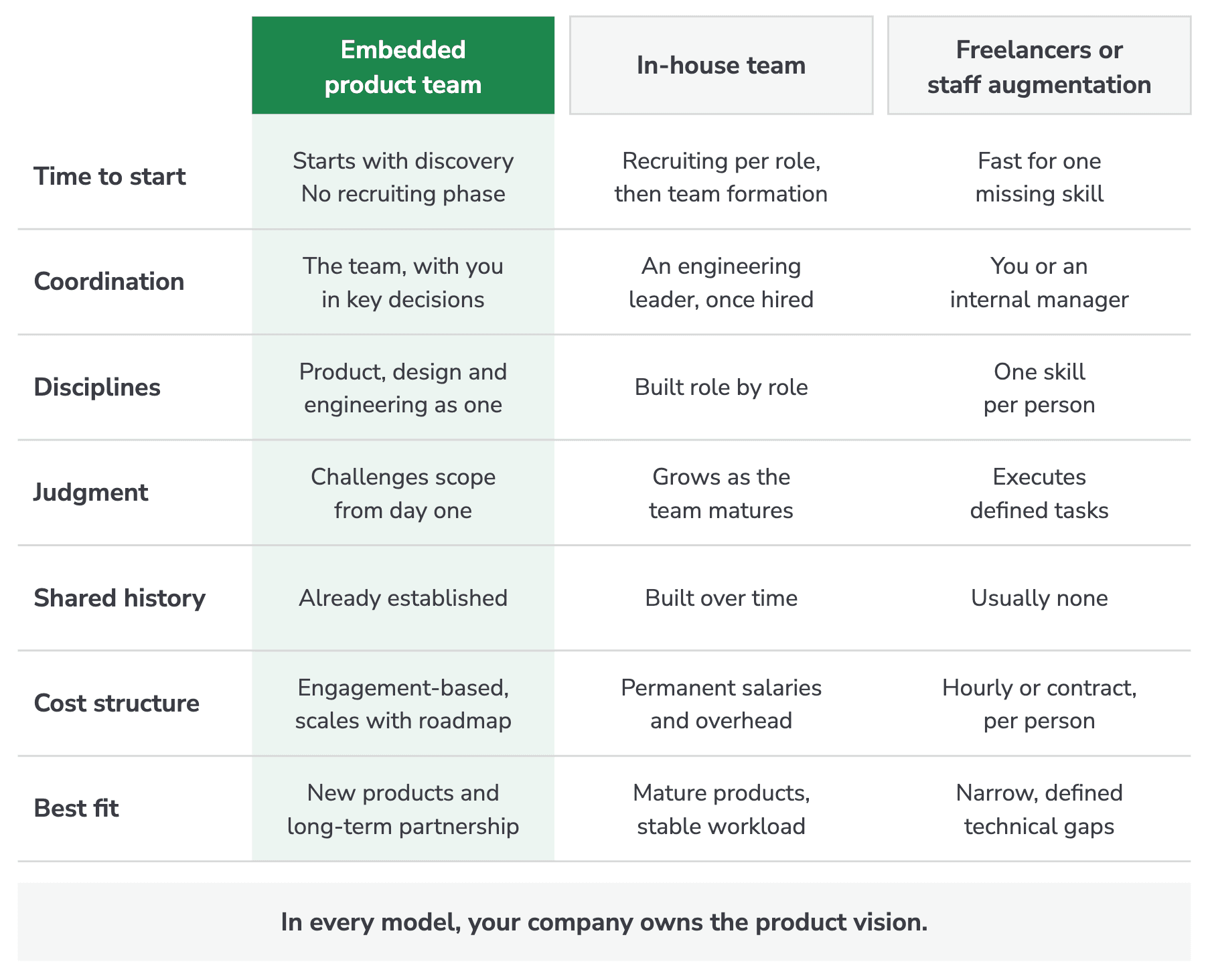
How the three team models compare. In every model, your company owns the product vision.
An embedded product team starts with discovery and has no recruiting phase. The team handles coordination, with you in key decisions. It covers product, design and engineering as one unit, challenges scope from day one, and brings an established working history. Its cost is engagement-based and scales with the roadmap. It fits new products and long-term partnership.
An in-house team starts after recruiting each role and forming the team. An engineering leader coordinates once hired. Disciplines are built role by role, product judgment grows as the team matures, and shared history builds over time. Its cost is permanent salaries and overhead. It fits mature products with a stable workload.
Freelancers or staff augmentation are fast for one missing skill. You or an internal manager coordinate, each person covers one skill and executes defined tasks, and there is usually no shared history. Cost is hourly or by contract, per person. This model fits narrow, defined technical gaps.
In every model, your company owns the product vision.
How to Evaluate a Software Development Partner
A polished portfolio is insufficient. Founders should examine how the team makes decisions.
Ask prospective partners:
- Who will challenge my assumptions? A team that only agrees transfers product risk back to the founder.
- Will the same people remain with the product? Continuity protects product context. It also keeps estimates reliable.
- How do product, design and engineering work together? Separate handoffs create delay and information loss.
- How do you decide what belongs in the first release? The answer reveals whether the team understands validation and commercial priorities.
- How do you use AI in delivery? Look for specific practices around review, testing and security, with clear accountability for the result. Our CTO covers this in why AI coding tools pay off for senior engineers.
- How will we measure progress? Completed tasks measure activity. Product milestones and user outcomes measure progress.
- How can the company take full ownership later? The code, documentation, infrastructure and operating knowledge should support a future internal team.
A strong software development partner should explain its reasoning in business terms. Technical depth matters. So does the ability to show which technical decisions change cost and risk, and which ones move the launch date.
A Founder Assessment
Start with two questions.
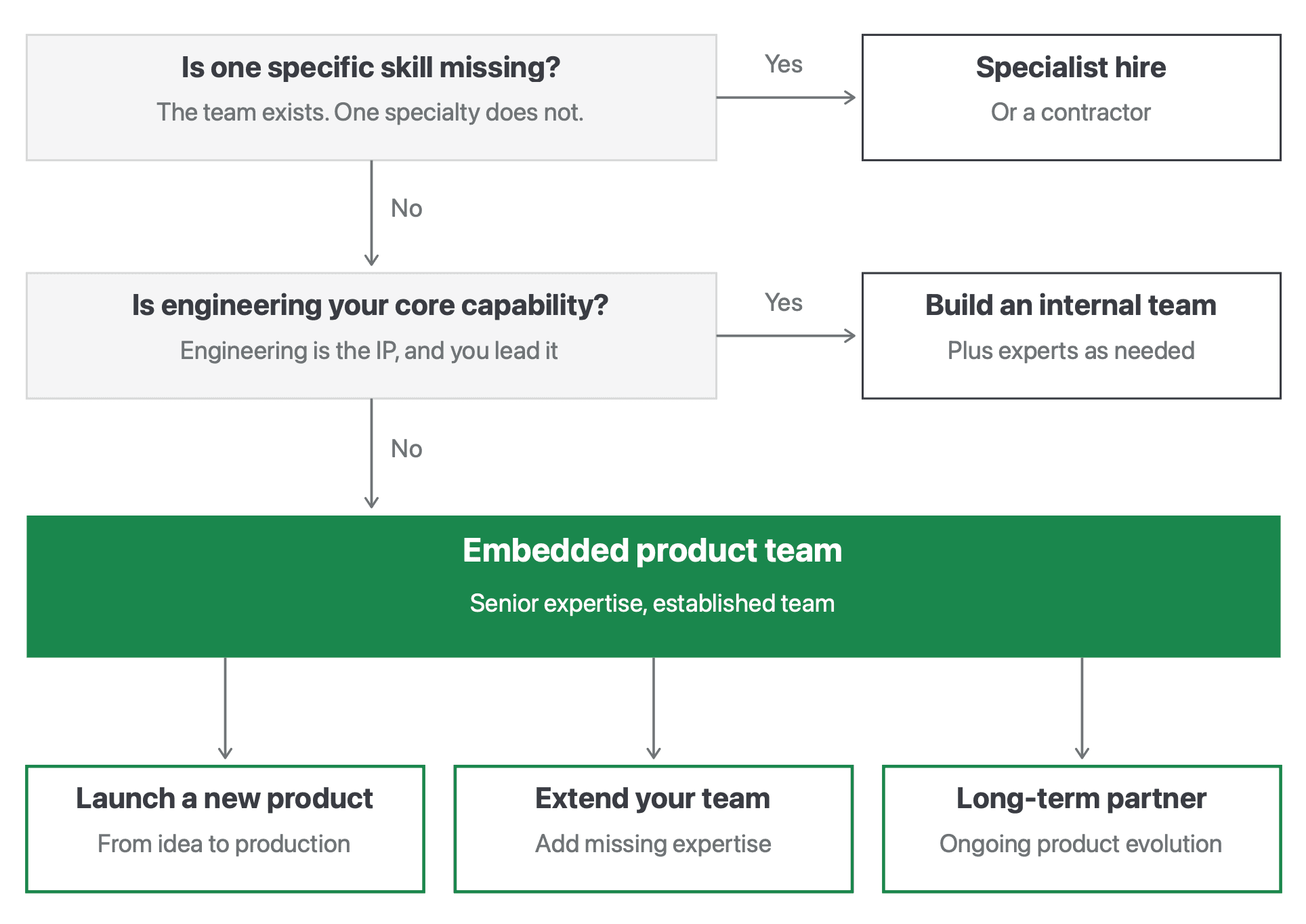
Two questions to match the team model to your company. The embedded path covers product launches, added expertise and long-term partnership.
If the tree points to an embedded product team, test the answer against these statements. It may be appropriate if most of them describe your company:
- We have a strong product thesis but need help turning it into a technical plan.
- Our next market milestone has a defined deadline.
- We need several product disciplines but cannot justify several permanent hires yet.
- The founder wants to remain closely involved in product decisions.
- We need a team capable of refining requirements during development.
- Product quality and future scalability matter beyond the first demonstration.
- Recruiting the full team would delay customer learning or revenue.
If one narrow technical skill is missing, a specialist hire or contractor may be enough.
If the company already has effective product leadership and a complete engineering organization, strengthening the internal team may create more value.
The goal is to select the operating model that fits the current stage.
If most of these statements describe your company, book a working session with our team. We will review your product plan and tell you which model fits.
Frequently Asked Questions
Should a startup hire developers or work with a development partner?
It depends on the stage. A startup that needs several disciplines working as one team, without building an engineering department, usually reaches production faster with an embedded product team.
How long does it take to hire a software engineer?
LinkedIn reports an average of 66 days to fill a role. Specialized technical and engineering positions can take three to six months or longer. A cross-functional product team usually requires several hires, followed by time for the new team to form working relationships.
What is the difference between an embedded product team and staff augmentation?
Staff augmentation adds individual contributors to a team that the client manages. An embedded product team brings product, design and engineering as one working unit. It shares responsibility for the product outcome, while the founder keeps ownership of the vision and priorities.
Can an embedded team hand the product over to an internal team later?
Yes, if the handover is planned from the start. Code, documentation, architecture records, infrastructure and product context should remain in the company's own systems. The embedded team can help define the permanent roles and onboard the first internal hires.
Does an embedded product team use AI tools?
A senior team should use AI throughout delivery, with human review and clear accountability. At Pieoneers, senior engineers use tools such as Claude Code for planning, implementation and review, and every change is reviewed before it reaches production.
Product Ownership with a Ready Team
Founders should retain control of the problem, the product direction and the decisions that create differentiation.
They can begin meaningful engineering before assembling every function internally.
Pieoneers is a Vancouver-based senior software consultancy, founded in 2009, working with companies across Canada and the US. We work as an embedded product and engineering team for founders and established companies building web, mobile, health-tech and AI-enabled products. Our team brings established working relationships and production experience to each engagement, along with the product judgment to know what is worth building.
We work closely enough with founders to carry the technical side of the product while the vision continues to evolve.
The founder owns the product. The team makes it real.
Discuss your product with Pieoneers or book a working session.
References
- LinkedIn Talent Blog. 7 Ways to Reduce Your Time to Fill. February 24, 2025.
- LinkedIn Talent Blog. What Is Talent Acquisition?
- Huckman, Robert S.; Staats, Bradley R.; Upton, David M. Team Familiarity, Role Experience, and Performance: Evidence from Indian Software Services. Management Science, 55(1), 2009.
- McKinsey & Company. What Makes Product Teams Effective? December 10, 2024.
- DORA, Google Cloud. State of AI-assisted Software Development. 2025.
- Dell'Acqua, Fabrizio et al. The Cybernetic Teammate: A Field Experiment on Generative AI and Teamwork. Organization Science.
- Dell'Acqua, Fabrizio et al. The Cybernetic Teammate: A Field Experiment on Generative AI Reshaping Teamwork and Expertise. Harvard Business School Working Paper No. 25-043, March 2025.

Olena Tkhorovska
CEO at Pieoneers