
← Go back
First-Mover Advantage in AI: From Demo to Production
 Andrew Manshin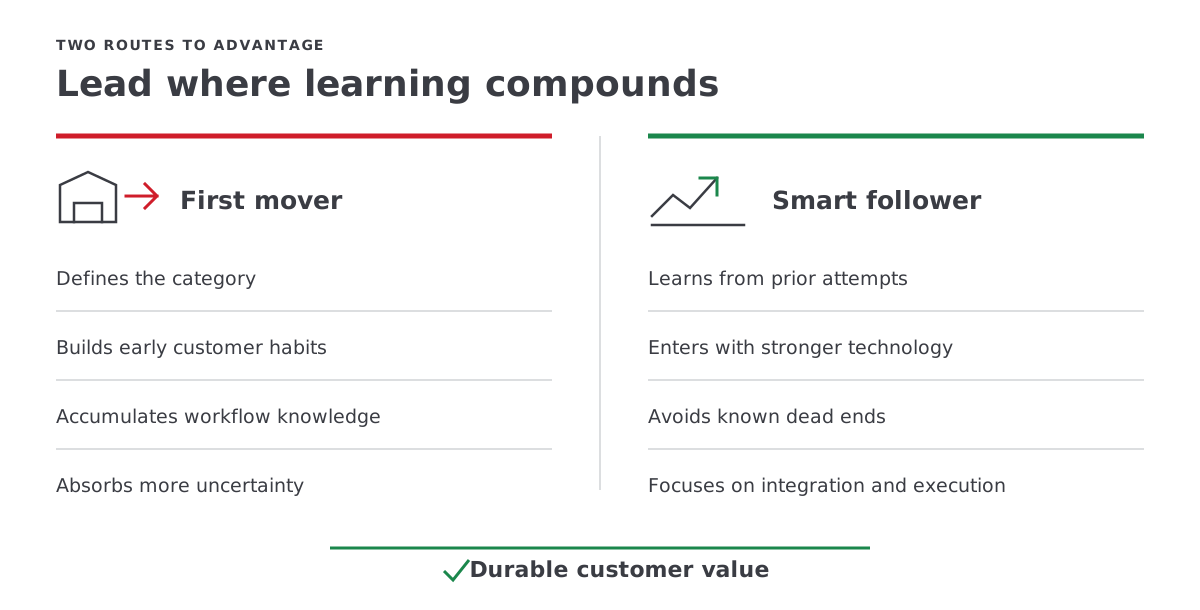
Comparison of first-mover and smart-follower strategies for building durable customer value.
What years of building with ambitious founders taught us about timing, production readiness, and where innovation really comes from. One recent voice-first field application brought the lesson into focus.
Over the years, Pieoneers has worked with many founders entering markets early. Some were creating a category. Others were applying newly viable technology to a problem established companies had overlooked.
Their stories suggest that being first is rarely the whole advantage. What matters is what a company learns while it is early. The advantage grows when that learning becomes a product, workflow, distribution channel, or customer relationship that is difficult to replace.
That is also the logic behind building from first principles: start with the human problem, question inherited constraints, and use new technology where it creates a meaningfully better experience.
Recently, Pieoneers built a voice-first application for technical professionals working in noisy, safety-sensitive environments. The goal was practical: let people capture structured field information without stopping work to type.
The application was substantial. Its frontend used React and TypeScript, supported by a Fastify API and PostgreSQL. Voice interactions ran through GPT-Realtime-2.1 and the OpenAI Realtime API. The broader full-stack platform included Railway, Cloudflare R2, Resend, Google Maps APIs, CI/CD, and roughly 1,500 automated tests. We designed the workflow and safety architecture so the system could confirm critical information, preserve records, and avoid treating uncertain speech as fact.
In controlled conditions, it worked. In real field conditions, the central voice experience was not reliable enough.
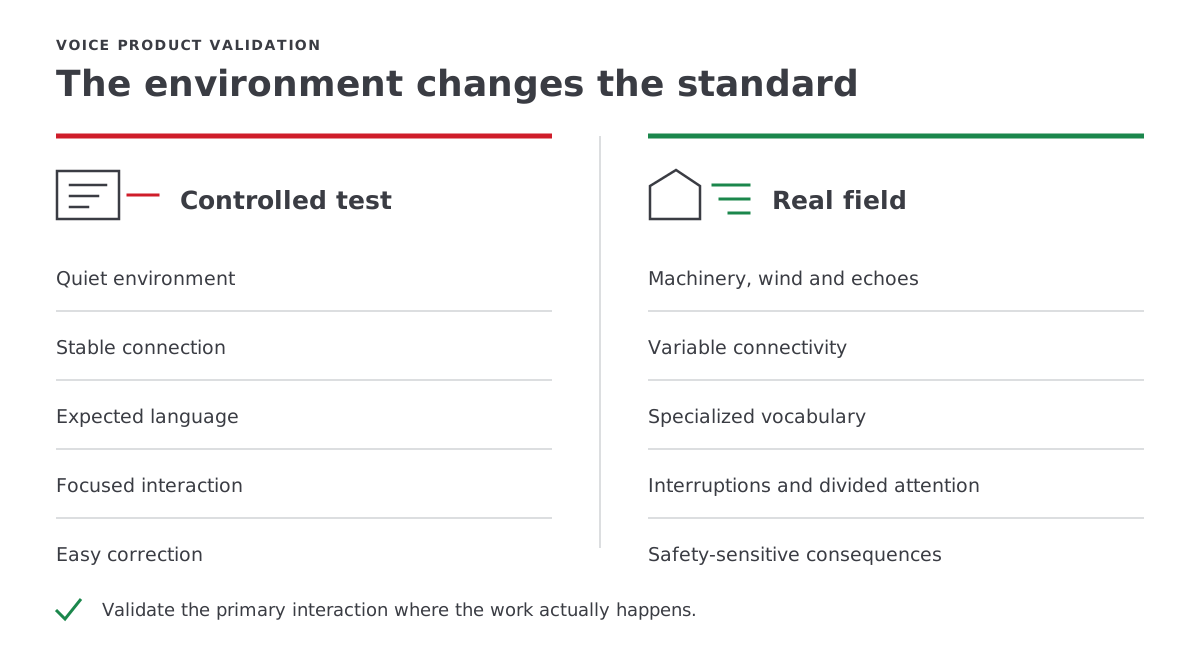
Controlled testing compared with real field conditions for a voice-first AI application.
Background machinery, protective equipment, inconsistent connectivity, specialized vocabulary, interruptions, and the natural pressure of field work created a much harder environment than a quiet office. The application, workflow, infrastructure, and safety controls performed as designed. But if voice is the primary interface, “usually understood” is not a production standard. Users must also keep their attention on physical work.
We built and validated a serious application, learned how the workflow should operate, and established a sound technical and safety foundation. We also learned that the core voice layer was not yet ready for the conditions that mattered most.
That distinction matters.
Roughly 1,500 automated tests gave us confidence in the parts of the system we controlled. They covered application logic, data handling, workflow behaviour, integrations, and safety controls. They could not prove that speech would remain reliable beside operating equipment, through protective gear, over inconsistent connections, or during interrupted conversations.
Test coverage tells us whether known behaviour remains stable. Field validation tells us whether the assumptions behind the product survive contact with reality.
A working demo is not a production product
We have written about this transition as the prototype confidence gap: functional completeness becomes visible early, while many qualities that determine whether a business can depend on the product remain below the surface.
Andreessen Horowitz put the problem plainly in its June 2025 article, “From Demos to Deals: Insights for Building in Enterprise AI”: flashy AI demos are easy; substantive products are hard. The authors argue that the demo-to-product gap is especially wide in AI because models are nondeterministic, user behaviour is unpredictable, customer data is messy, and real products must handle a long tail of exceptional cases.
Our experience was a physical-world version of that gap. A good voice demonstration answers, “Can the model understand this exchange?” A production field product must answer harder questions:
- Can it understand the exchange beside operating equipment?
- Can it recover from interruptions without losing context?
- Can it distinguish similar technical terms consistently?
- Can it signal uncertainty before uncertain input enters a record?
- Can it remain safe when the network degrades?
- Can users trust it repeatedly, not just during a prepared test?
Voice reliability is more than transcription accuracy. The system must detect when someone has finished speaking, respond with acceptable latency, preserve context after an interruption, distinguish specialized terms, and recover cleanly when connectivity degrades. Each layer can perform reasonably well on its own while the combined experience still falls below the threshold users need.
Production readiness belongs to the complete interaction, not to a model benchmark.
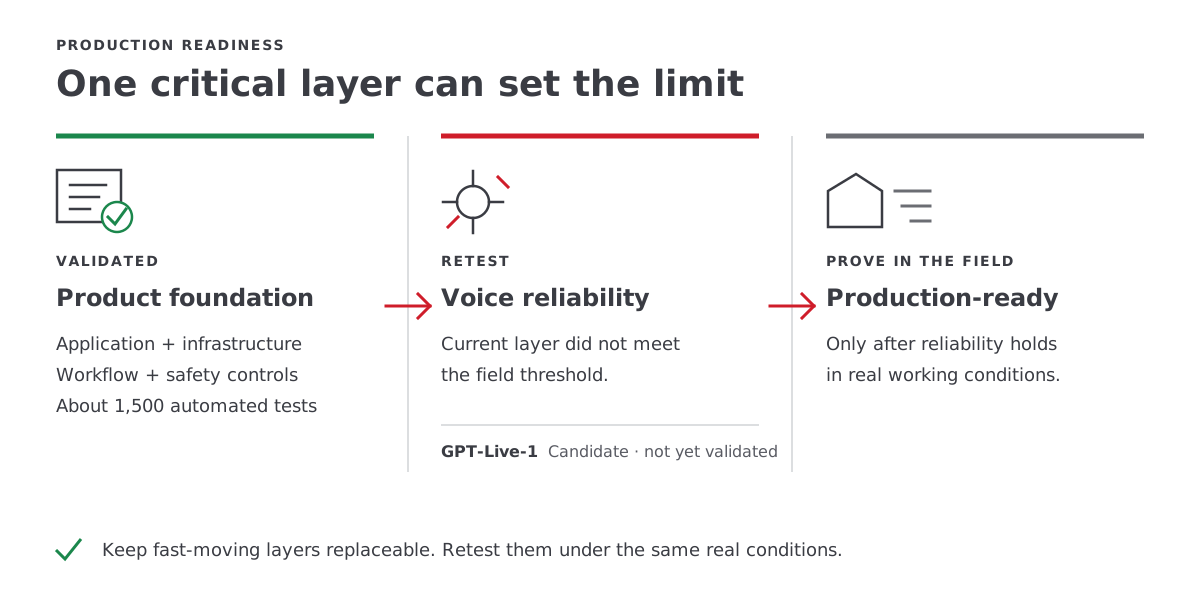
AI production-readiness process from validated product foundation to field-tested voice reliability.
The surrounding product can be thoughtfully designed and well engineered while one enabling layer remains below the required threshold. That is not the same as building a failed prototype. It is evidence about readiness.
On September 10, 2026, OpenAI released GPT-Live-1, a newer voice layer for the API. OpenAI describes full-duplex conversation, improved interruption handling, built-in transcripts, keyword biasing, turn detection, and flexible WebRTC, WebSocket, and telephony connections. Those capabilities may address parts of the problem we encountered.
But newer is not the same as validated. GPT-Live-1 has not yet been tested by Pieoneers against the same field conditions, vocabulary, devices, connectivity, and acceptance criteria. Until it is, it remains a promising candidate. It is not yet a conclusion.
Being first is not the same as building an advantage
This distinction has become more urgent in the AI market. In their July 2025 NFX essay, “The False-Positive Incumbent”, Morgan Beller and Daniel Museles argue that early momentum can create the appearance of durable leadership before a company has built it. First movers may validate a market, while a later entrant wins through stronger retention, economics, workflow integration, or technology.
Bessemer Venture Partners makes a complementary point in its July 29, 2025 product-market-fit playbook for AI founders. AI products are often category creators or first movers, but initial enthusiasm is only a light signal. Novelty becomes durable value when usage is repeatable and the product becomes part of the customer’s real work.
A first mover can define the category, learn before competitors, build distribution, establish customer habits, and become the name buyers associate with the problem. Those benefits are powerful only when the company turns them into something that compounds.
In other words, being first is a position. It is not a moat by itself. When technology changes rapidly, a follower may enter with a better foundation before the pioneer can recover its investment.
This is particularly relevant to AI. The product idea may remain sound while the enabling model changes underneath it.
Timing is a product decision
Pete Flint’s July 2019 NFX essay, “Why Startup Timing Is Everything”, describes successful timing as a convergence of technology, economic conditions, and cultural acceptance. A market reaches critical mass when the surrounding conditions make adoption possible, useful, and natural.
Marc Andreessen makes a similar observation in a16z’s July 1, 2025 discussion, “Marc Andreessen on Startup Timing”: being too early can feel exactly like being wrong.
A 2026 Bessemer case study of Strella offers a recent voice-AI example. Its founders spent a year exploring the problem and launched after voice technology crossed the quality threshold required for real-time interviews. Their durable advantage came from solving use-case-specific problems across the complete research workflow.
The voice-first field application makes this concrete. The need exists. The economic case is clear. Users already understand voice interfaces. Yet the final threshold is contextual reliability: does the technology perform well enough in the environment where its value is supposed to appear?
Timing is not simply a question of launching this year or next. Good product planning and strategy can sequence the product so that proven elements create value now while a fast-moving layer remains replaceable and testable.
That replaceability has to be designed. A speech provider’s event formats, session behaviour, and transcription assumptions should not spread through the entire codebase. A dedicated integration layer can translate them into stable product concepts such as transcript updates, interruptions, confirmations, uncertainty, and failure states.
Providers are not interchangeable in practice. Their latency, behaviour, and capabilities differ. A clear boundary still lets the team evaluate a new voice layer without rebuilding the workflow, data model, or safety architecture. Modularity matters most where uncertainty is highest.
When moving first creates momentum
One of our client’s projects is a great example. I personally worked on this project at great depth and with all my passion. GameSheet shows what a successful early move can look like. The company replaced paper game sheets with an iPad application for recording youth-sports events and publishing results to league websites. In our GameSheet case study, we showcase how the original product proved the market with a relatively small user base. Soon after, the Ontario Minor Hockey Association selected GameSheet as its exclusive electronic game-sheet vendor, increasing the expected user base from under one thousand to tens of thousands.
GameSheet had the ingredients that can turn an early lead into a durable advantage: a clear operational problem, familiar user behaviour, institutional adoption, accumulated product learning, and a platform able to scale. At Pieoneers, we rebuilt the architecture for that growth while preserving the paper game sheet’s familiar mental model. The product also worked without Wi-Fi while recording a game. That was an important fit with the conditions inside arenas.
The lesson is not merely “launch first.” GameSheet paired category leadership with workflow fit and production execution.
Smart followers innovate differently
A smart follower does not simply copy a first mover. They wait, learn, and combine proven components around a sharper understanding of the user’s problem.
Jevitty and BodyComp illustrate this pattern. Neither project depended on inventing mobile operating systems, cloud storage, medical imaging, or APIs. The innovation came from connecting mature capabilities into a coherent health workflow.
For Jevitty, Pieoneers developed a mobile health platform that brings health information into one experience. The Jevitty case study describes its integration with BodyComp so users can securely access medical images and body-composition reports and compare scans over time.
The BodyComp case study shows the other side of that connection: a secure technician platform, encrypted data handling, two-factor authentication, report processing, and an API that makes scan data available within Jevitty. The components were proven. The product value came from their integration, the security model, and the resulting experience for patients and technicians.
That is real innovation. It is often more defensible than novelty at a single technical layer because it embeds domain knowledge in an end-to-end workflow.
Bessemer Venture Partners makes a related argument in “Building Vertical AI: An Early Stage Playbook for Founders”, published January 2026. The playbook emphasizes selecting workflows where AI creates genuine value, proving return on investment, building for the requirements of a specific industry, and keeping systems modular enough to adopt better models as they emerge.
For many founders, that is the stronger pattern: move early on the workflow, but avoid locking the company to an immature implementation of the enabling technology. Effective AI development and integration treats the model as one part of the product rather than the product’s entire foundation.
Choosing where to lead and where to follow
“First mover or second mover?” is too broad a question. A product can lead in one layer and follow in another.
You might be first to define a workflow, serve an overlooked user, establish a distribution channel, or integrate data that has never been useful in one place. At the same time, you might deliberately follow on speech models, payments, mapping, hosting, or identity because those layers improve faster and more safely at platform scale.
Before betting on an early move, ask:
- Where can an early lead compound? Look for learning, distribution, proprietary data, trust, scarce partnerships, network effects, or meaningful switching costs.
- Which dependency could invalidate the experience? Test the least mature critical layer in the actual environment, not only in a demo setting.
- How expensive is waiting? Delay can surrender a category, but it can also prevent a costly commitment to technology that is about to change.
- Can the architecture absorb the next generation? Keep fast-moving model and infrastructure layers replaceable where practical. A clear product architecture makes those boundaries explicit before implementation decisions become difficult to reverse.
- What is the safe fallback? In high-consequence workflows, uncertainty needs an explicit product response: confirmation, human review, manual input, or a controlled stop.
- What evidence defines production-ready? Set field acceptance criteria before enthusiasm for a demo changes the standard.
The practical advantage is informed timing
First movers can win by learning early and turning that learning into a system competitors struggle to displace. Smart followers can win by avoiding the pioneer’s dead ends, entering on stronger technology, and executing the complete workflow better.
Both can be innovative.
The harder discipline is knowing what the market is ready for, what the technology is ready for, and which part of the opportunity is worth leading today. Our field-app experience did not disprove voice as an interface. It clarified the conditions the voice must meet before it can carry the product.
The application, workflow, tests, infrastructure, and safety architecture now provide a strong basis for that next evaluation. GPT-Live-1 may move the boundary. Only testing under the same real conditions will tell.
The goal is not to be first everywhere. It is to be early where learning compounds, patient where dependencies are immature, and excellent where users feel the result. When the idea and workflow are proven, the next step is turning that evidence into a production-ready product.
References
- Beller, Morgan, and Daniel Museles. “The False-Positive Incumbent.” NFX, July 2025.
- Bessemer Venture Partners. “Mastering Product-Market Fit: A Detailed Playbook for AI Founders.” July 29, 2025.
- Tan, Kimberly; Joe Schmidt; Marc Andrusko; and Olivia Moore. “From Demos to Deals: Insights for Building in Enterprise AI.” Andreessen Horowitz, June 24, 2025.
- Andreessen, Marc, and Jonathan Lai. “Marc Andreessen on Startup Timing.” Andreessen Horowitz, July 1, 2025.
- Bessemer Venture Partners. “Strella: Launching AI Products That Win.” April 2026.
- Bessemer Venture Partners. “Building Vertical AI: An Early Stage Playbook for Founders.” January 6, 2026.
- Flint, Pete. “Why Startup Timing Is Everything.” NFX, July 2019.
- OpenAI. “Build More Natural Voice Experiences with GPT-Live-1 in the API.” September 10, 2026.
Related services

Andrew Manshin
CTO at Pieoneers